When I first started this blog, its mandate was to talk about engineering-lifestyle things, like freaking out about midterms and being jealous of MIT. I've strayed a bit from that ideal over the years, but I'd like to get back to it now with a discussion about the quintessential student pastime of wasting time on the internet.
Now, since you're reading my blog, I'm going to take it for granted that you already appreciate the benefits of spending time on online activities that are not, strictly speaking, useful. With that in mind, we can skip the moral questioning and get straight to the fun stuff: did you know you can download parts of Wikipedia as books?
It's true. I'm not referring to WikiBooks either, which are notoriously incomplete and haphazardly edited, but actual PDFs/ODT files/ZIM files/physical books made from the content of Wikipedia itself.
This might not sound like that much of a time waster, because navigating Wikipedia the conventional way is probably even more of a time waster due to all the link-hopping. Reading a book of encyclopedia articles could also be considered a constructive use of time. To both of these objections I present: this six hundred page book of chess variants. Clearly this is a waste of time and something I would never have wasted time on before it became possible to load onto an e-reader.
So you now have a couple thousand new books to read (starting, perhaps, with Philosophy of Science, Neuroscience, LGBT themes in science fiction, fantasy and horror, Consciousness, Complex Dynamics, or University Genetics). Interestingly, Creationism and Intelligent Design is one of the larger books, probably because the arguments, lawsuits, and politics involved are distressingly entertaining.
Moving along, I've also taken to wasting a fair amount of time on the Khan Academy site. Again, studying mathematics through a tutoring site (an incredibly good tutoring site with video tutorials from one instructor spanning topics from basic addition to vector calculus) might seem like a benign time waster, but I assure you it is quite possible to spend far too long there.
For one thing, the Khan Academy has discovered that the future is games and uses a gaming-inspired reward system to motivate students to study more. This only affects people who log into the site (with a Google or Facebook account) but should you be so unwise as to do so, you'll suddenly have the option to gain lots of points by watching video lectures and answering simple interactive math tests. Since the tests are aimed more at the elementary level than the university level, it is quite possible to gain ludicrous amounts of utterly meaningless points in the span of a few hours if you're willing to answer lots of arithmetic questions. I don't personally recommend doing this but, having done it, I have a renewed appreciation for not having to manually multiply dozens of three-digit number pairs together for homework anymore.
Seriously though, Khan Academy has a lot of good stuff for anyone who wants to learn stuff (mostly math, but there's a couple biology, chemistry, and history videos available for good measure). It's a similar type of time waster as watching lots of TED talks and you can even combine the two by watching a TED talk about Khan Academy.
In other news, I have a free unlimited internet connection and am really good at arithmetic again for no apparent reason.
In actual other news: brains, concepts, plasticity, self-organizing, going to CogSci 2011 woohoo, Shad BrainLab, iGEM, software, interfaces, coding Saturday, going to be awesome, can't say much about any of these things, but they're all awesome.
Showing posts with label math. Show all posts
Showing posts with label math. Show all posts
Wednesday, June 29, 2011

Wednesday, April 6, 2011
Best day... ever?
I was hoping to write a proper post about this, but I am somewhat too tired to do so, so I'll resort to posting a schedule of the day.
9:15 AM: Sebastian Seung (MIT) [I am my connectome TED Talk, on Youtube].
10:45 AM: Peter Strick (Pittsburgh): Motor control and basal ganglia / cerebellum topography.
1:30 PM: Jonathan Cohen (Princeton): Adaptive cognitive control.
3:00 PM: Ned Block (NYU, Philosophy) [On Consciousness Youtube clip].
[End of Brain Day]
7:00 PM: Perimeter Institute lecture by Roger Penrose [Discover Magazine article]
10:00 PM: Read web comics. There was a good crop today!
EDIT: Apparently Ryan North of Dinosaur Comics was also at the Perimeter Institure lecture. I'm kinda disappointed I spent too much time listening to the lecture to notice this.
EDIT: Apparently Ryan North of Dinosaur Comics was also at the Perimeter Institure lecture. I'm kinda disappointed I spent too much time listening to the lecture to notice this.
Wednesday, March 2, 2011
Nomograms for Synbio
I've always really liked nomograms. They're basically a set of axes drawn on a page in such a way that each axis represents one (or more) variables and by drawing lines between the various axes, it's possible to find unknown variables graphically.
One of the most basic nomograms possible simply adds two numbers:
 From this simple beginning, it's possible to make other analog computation devices that are much more sophisticated. By using logarithmic axes, you can perform multiplication, since log(x) + log(y) = log(xy).
Nomograms are rather outdated, now that computers can perform numerical calculations much more easily and with far greater accuracy than anyone can measure by hand. The reason I'm looking into nomograms again is because they can be distributed on paper more easily than a computer program, they are relatively intuitive, and they allow very complex systems of equations to be solved by people who don't know math. There are also some iGEM outreach events coming up...
 ...so we'd like to be able to show people mathematical modelling stuff that's related to synthetic biology, but it's hard to come up with stuff that's interesting, learnable in minutes, and true. I think it's possible to condense some tricky work into a graph:

The above graph shows a setup that could calculate the concentration of a molecule and its isomers given a reaction rate constant (provided the axes were properly scaled). This is a fair amount of work (for the creator of the nomogram) when you could just plug "exp(-k*t)" into a calculator, but it's hard to beat the connect-the-dots simplicity of a nomograph. The other nice thing about this type of graph is that it really emphasizes the fact that it's easy to 'cheat' and start with the desired final answer and work backwards to get inputs... ie, design the system analytically.
Unfortunately, the irreversible isomerization reaction is still rather lame and even with an easy method of calculating it, it's still not particularly exciting. What would be cool would be to get a system of equations that describes an optimization problem and have a graph visually represent design trade-offs (like the triangular graph on this page), but that sounds like it might be too ambitious for me to tackle in a couple of spare hours.
One of the most basic nomograms possible simply adds two numbers:
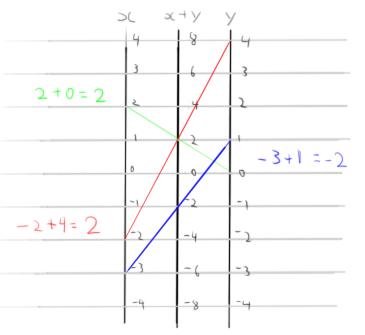 From this simple beginning, it's possible to make other analog computation devices that are much more sophisticated. By using logarithmic axes, you can perform multiplication, since log(x) + log(y) = log(xy).
Nomograms are rather outdated, now that computers can perform numerical calculations much more easily and with far greater accuracy than anyone can measure by hand. The reason I'm looking into nomograms again is because they can be distributed on paper more easily than a computer program, they are relatively intuitive, and they allow very complex systems of equations to be solved by people who don't know math. There are also some iGEM outreach events coming up...
 ...so we'd like to be able to show people mathematical modelling stuff that's related to synthetic biology, but it's hard to come up with stuff that's interesting, learnable in minutes, and true. I think it's possible to condense some tricky work into a graph:
The above graph shows a setup that could calculate the concentration of a molecule and its isomers given a reaction rate constant (provided the axes were properly scaled). This is a fair amount of work (for the creator of the nomogram) when you could just plug "exp(-k*t)" into a calculator, but it's hard to beat the connect-the-dots simplicity of a nomograph. The other nice thing about this type of graph is that it really emphasizes the fact that it's easy to 'cheat' and start with the desired final answer and work backwards to get inputs... ie, design the system analytically.
Unfortunately, the irreversible isomerization reaction is still rather lame and even with an easy method of calculating it, it's still not particularly exciting. What would be cool would be to get a system of equations that describes an optimization problem and have a graph visually represent design trade-offs (like the triangular graph on this page), but that sounds like it might be too ambitious for me to tackle in a couple of spare hours.
Wednesday, November 25, 2009
Lockhart's Lament
This article on K12 math education was written in 2002, but it finally found its way onto my class's Google group in the past couple days: http://plato.asu.edu/LockhartsLament.pdf
Before you dash off to read it, I should note that there are a couple big flaws with the argument. The main one is that he claims that math is useless and that this is a good thing. Math is not useless and it would not be a good thing if it were. Further arguments are below, but you can go read the article first.
--- Waiting. Go read the article. ---
Okay. You've read it? Here we go...
FURTHER ARGUMENTS
Lockhart's stance that math is art and thus useless (but capable of, you know, enlightening people...) does a disservice to both artists and mathematicians. Sure, art can be done for art's sake, but good art is done because people (even people who are not the artists themselves!) like it and it is thus useful.
Indeed, Lockhart's view of art reminds me a lot of List A pieces from the Royal Conservatory of Music. These are the classical, historic masterpieces that are critically acclaimed and all that [lack of] jazz, but are dead boring to a lot of modern students, such as myself. Music, art, and math do not exist in a vacuum. They are made better by being applied to the real world, to real situations, and to real problems.
Lockhart asserts that trigonometry is useless to most people's lives; this is clearly for lack of trying. Trigonometric functions provide a basis for the analysis of all periodic systems, from electrical circuits, to mechanical oscillators, many biological processes, and so forth. Can the beauty of the periodicity of a periodic function be appreciated without realizing this? Sure, maybe, for some people who would undoubtedly make fine mathematicians. There are, however, many cases where math is not developed for its beauty, but for its practical application. Take the Dirac delta function: a vertical spike at the origin of infinite height but with area one. Does that sound beautiful? (Okay, honestly, it does to me, but that's mainly because I've read ahead.) It's hard to imagine someone coming up with the impulse function for purely aesthetic reasons — as it goes against pretty much everything math has to say about functions — but it turns out to be extremely useful (I mean, man, you have know idea how important this one concept is, seriously, yow) for signal processing and the design of linear-time invariant systems (ie. not quite everything, but a large subset of everything).
The point that I want to make though is that the art metaphor is not flawed, but Lockhart annoyingly neglects the idea of pop art (stuff that people can actually relate to) for stuffy avant-garde postmodern cruft that can supposedly be admired for its intrinsic celestial beauty. Art is only art because it has context; math is only math because it is grounded in applications. To paraphrase Lady Gaga, pop culture will never be lowbrow.
Thanks for reading!
P.S. For those of you who have noticed that I drop a lot more Lady Gaga references now than I did before, it's because I need an excuse to link to this video which is awesome. I don't care what you think of dance pop, if you can play the piano with your foot that is damned impressive.
Before you dash off to read it, I should note that there are a couple big flaws with the argument. The main one is that he claims that math is useless and that this is a good thing. Math is not useless and it would not be a good thing if it were. Further arguments are below, but you can go read the article first.
--- Waiting. Go read the article. ---
Okay. You've read it? Here we go...
FURTHER ARGUMENTS
Lockhart's stance that math is art and thus useless (but capable of, you know, enlightening people...) does a disservice to both artists and mathematicians. Sure, art can be done for art's sake, but good art is done because people (even people who are not the artists themselves!) like it and it is thus useful.
Indeed, Lockhart's view of art reminds me a lot of List A pieces from the Royal Conservatory of Music. These are the classical, historic masterpieces that are critically acclaimed and all that [lack of] jazz, but are dead boring to a lot of modern students, such as myself. Music, art, and math do not exist in a vacuum. They are made better by being applied to the real world, to real situations, and to real problems.
Lockhart asserts that trigonometry is useless to most people's lives; this is clearly for lack of trying. Trigonometric functions provide a basis for the analysis of all periodic systems, from electrical circuits, to mechanical oscillators, many biological processes, and so forth. Can the beauty of the periodicity of a periodic function be appreciated without realizing this? Sure, maybe, for some people who would undoubtedly make fine mathematicians. There are, however, many cases where math is not developed for its beauty, but for its practical application. Take the Dirac delta function: a vertical spike at the origin of infinite height but with area one. Does that sound beautiful? (Okay, honestly, it does to me, but that's mainly because I've read ahead.) It's hard to imagine someone coming up with the impulse function for purely aesthetic reasons — as it goes against pretty much everything math has to say about functions — but it turns out to be extremely useful (I mean, man, you have know idea how important this one concept is, seriously, yow) for signal processing and the design of linear-time invariant systems (ie. not quite everything, but a large subset of everything).
The point that I want to make though is that the art metaphor is not flawed, but Lockhart annoyingly neglects the idea of pop art (stuff that people can actually relate to) for stuffy avant-garde postmodern cruft that can supposedly be admired for its intrinsic celestial beauty. Art is only art because it has context; math is only math because it is grounded in applications. To paraphrase Lady Gaga, pop culture will never be lowbrow.
Thanks for reading!
P.S. For those of you who have noticed that I drop a lot more Lady Gaga references now than I did before, it's because I need an excuse to link to this video which is awesome. I don't care what you think of dance pop, if you can play the piano with your foot that is damned impressive.
Tuesday, March 10, 2009
How to Buy an Airline Ticket
Well, I can finally say I've attended an MIT lecture. Dr. Belobaba from MIT's International Center for Air Transportation (ICAT) dropped by today to give a guest lecture on the topic of airline pricing schemes and revenue management.
It was an interesting talk that did a good job of explaining why airlines feel the need to have multiple fares for the same flight and to sell tickets at different prices depending on when they're bought.
Basically, airlines want to sell as many high-priced tickets as possible, but they know that there are a lot of people who will only fly at lower costs, hence the need for differential pricing. Then of course, the people who were willing to pay more won't be quite as happy to part with their money if they know that someone else is getting the same service for the same price, which is why airlines introduced restrictions on low fare tickets including "Saturday night stay" conditions that prevent the type of quick round-trips that businesses require.
But on top of these differential pricing schemes, the airlines also use revenue management. That is, they reserve a certain number of the more expensive tickets based on statistical models for how many they believe they'll be able to sell. This is sensible enough, because if they know that they will eventually sell out a given number number of expensive tickets, they don't want those seats going to starving students who will only pay the cheap rate. Of course, they don't know how many tickets they'll be able to sell exactly, so that's where the probability comes in.
Technically, you look at the expected value of some probability function to do this, but all that means is that the cutoff for reserving a ticket of a certain class is the point at which you get the same number by multiplying the ticket's price by its probability of being sold as you do when you multiply the price of a cheaper ticket by its probability of being sold.
Anyway, what this all boils down to is that, first of all, you won't get the super cheap tickets months in advance, regardless of the probabilities, because airlines know they'll be able to unload those later relatively easily. The cheap tickets actually start appearing once the revenue management system kicks in and it realizes that the expensive tickets are being undersold. Now, if the expensive tickets are actually selling really well than you can forget about the cheap ticket and start wishing you had bought one before the prices tripled, however the upshot of all this is that given the statistical anomaly that is the current economy the model forecasts might be overshooting slightly.
It was an interesting talk that did a good job of explaining why airlines feel the need to have multiple fares for the same flight and to sell tickets at different prices depending on when they're bought.
Basically, airlines want to sell as many high-priced tickets as possible, but they know that there are a lot of people who will only fly at lower costs, hence the need for differential pricing. Then of course, the people who were willing to pay more won't be quite as happy to part with their money if they know that someone else is getting the same service for the same price, which is why airlines introduced restrictions on low fare tickets including "Saturday night stay" conditions that prevent the type of quick round-trips that businesses require.
But on top of these differential pricing schemes, the airlines also use revenue management. That is, they reserve a certain number of the more expensive tickets based on statistical models for how many they believe they'll be able to sell. This is sensible enough, because if they know that they will eventually sell out a given number number of expensive tickets, they don't want those seats going to starving students who will only pay the cheap rate. Of course, they don't know how many tickets they'll be able to sell exactly, so that's where the probability comes in.
Technically, you look at the expected value of some probability function to do this, but all that means is that the cutoff for reserving a ticket of a certain class is the point at which you get the same number by multiplying the ticket's price by its probability of being sold as you do when you multiply the price of a cheaper ticket by its probability of being sold.
Anyway, what this all boils down to is that, first of all, you won't get the super cheap tickets months in advance, regardless of the probabilities, because airlines know they'll be able to unload those later relatively easily. The cheap tickets actually start appearing once the revenue management system kicks in and it realizes that the expensive tickets are being undersold. Now, if the expensive tickets are actually selling really well than you can forget about the cheap ticket and start wishing you had bought one before the prices tripled, however the upshot of all this is that given the statistical anomaly that is the current economy the model forecasts might be overshooting slightly.
Tuesday, March 3, 2009
If I Wrote a Textbook...

Godzilla's foot is towering 0.3m above Billy's head. If Godzilla's foot weighs 200 kg and Godzilla's leg muscles exert a force FA of 30 Newtons onto the foot acting downwards at an angle of 30 degrees to the horizontal ground plane (see diagram), how much time does Billy have to move to avoid being flattened?
See now this is the type of problem people can relate to.
[Bonus: Write a differential equation expressing a werewolf's rate of change with respect to the phase of the moon. Use this equation to calculate how quickly someone needs to be locked in a cage once they start transforming, given that signs of werewolf behavior are detectable after the transformation is 20 percent complete. Use a safety factor of 1.2 and assume the lock is sturdy.]
EDIT: A few corrections for the first problem: assume that Godzilla's foot is large enough that it's horizontal motion in the brief time before impact can be neglected and that the foot will indeed impact Billy if he does not move. Furthermore, assume the foot has no velocity at the instant depicted in the question. Resolution of ambiguities in the bonus question are left as an exercise to the student, but be sure to state all assumptions and reasoning.
Subscribe to:
Posts (Atom)

 Posts
Posts


