When I first started this blog, its mandate was to talk about engineering-lifestyle things, like freaking out about midterms and being jealous of MIT. I've strayed a bit from that ideal over the years, but I'd like to get back to it now with a discussion about the quintessential student pastime of wasting time on the internet.
Now, since you're reading my blog, I'm going to take it for granted that you already appreciate the benefits of spending time on online activities that are not, strictly speaking, useful. With that in mind, we can skip the moral questioning and get straight to the fun stuff: did you know you can download parts of Wikipedia as books?
It's true. I'm not referring to WikiBooks either, which are notoriously incomplete and haphazardly edited, but actual PDFs/ODT files/ZIM files/physical books made from the content of Wikipedia itself.
This might not sound like that much of a time waster, because navigating Wikipedia the conventional way is probably even more of a time waster due to all the link-hopping. Reading a book of encyclopedia articles could also be considered a constructive use of time. To both of these objections I present: this six hundred page book of chess variants. Clearly this is a waste of time and something I would never have wasted time on before it became possible to load onto an e-reader.
So you now have a couple thousand new books to read (starting, perhaps, with Philosophy of Science, Neuroscience, LGBT themes in science fiction, fantasy and horror, Consciousness, Complex Dynamics, or University Genetics). Interestingly, Creationism and Intelligent Design is one of the larger books, probably because the arguments, lawsuits, and politics involved are distressingly entertaining.
Moving along, I've also taken to wasting a fair amount of time on the Khan Academy site. Again, studying mathematics through a tutoring site (an incredibly good tutoring site with video tutorials from one instructor spanning topics from basic addition to vector calculus) might seem like a benign time waster, but I assure you it is quite possible to spend far too long there.
For one thing, the Khan Academy has discovered that the future is games and uses a gaming-inspired reward system to motivate students to study more. This only affects people who log into the site (with a Google or Facebook account) but should you be so unwise as to do so, you'll suddenly have the option to gain lots of points by watching video lectures and answering simple interactive math tests. Since the tests are aimed more at the elementary level than the university level, it is quite possible to gain ludicrous amounts of utterly meaningless points in the span of a few hours if you're willing to answer lots of arithmetic questions. I don't personally recommend doing this but, having done it, I have a renewed appreciation for not having to manually multiply dozens of three-digit number pairs together for homework anymore.
Seriously though, Khan Academy has a lot of good stuff for anyone who wants to learn stuff (mostly math, but there's a couple biology, chemistry, and history videos available for good measure). It's a similar type of time waster as watching lots of TED talks and you can even combine the two by watching a TED talk about Khan Academy.
In other news, I have a free unlimited internet connection and am really good at arithmetic again for no apparent reason.
In actual other news: brains, concepts, plasticity, self-organizing, going to CogSci 2011 woohoo, Shad BrainLab, iGEM, software, interfaces, coding Saturday, going to be awesome, can't say much about any of these things, but they're all awesome.
Showing posts with label learning. Show all posts
Showing posts with label learning. Show all posts
Wednesday, June 29, 2011

Wednesday, March 2, 2011
Nomograms for Synbio
I've always really liked nomograms. They're basically a set of axes drawn on a page in such a way that each axis represents one (or more) variables and by drawing lines between the various axes, it's possible to find unknown variables graphically.
One of the most basic nomograms possible simply adds two numbers:
 From this simple beginning, it's possible to make other analog computation devices that are much more sophisticated. By using logarithmic axes, you can perform multiplication, since log(x) + log(y) = log(xy).
Nomograms are rather outdated, now that computers can perform numerical calculations much more easily and with far greater accuracy than anyone can measure by hand. The reason I'm looking into nomograms again is because they can be distributed on paper more easily than a computer program, they are relatively intuitive, and they allow very complex systems of equations to be solved by people who don't know math. There are also some iGEM outreach events coming up...
 ...so we'd like to be able to show people mathematical modelling stuff that's related to synthetic biology, but it's hard to come up with stuff that's interesting, learnable in minutes, and true. I think it's possible to condense some tricky work into a graph:

The above graph shows a setup that could calculate the concentration of a molecule and its isomers given a reaction rate constant (provided the axes were properly scaled). This is a fair amount of work (for the creator of the nomogram) when you could just plug "exp(-k*t)" into a calculator, but it's hard to beat the connect-the-dots simplicity of a nomograph. The other nice thing about this type of graph is that it really emphasizes the fact that it's easy to 'cheat' and start with the desired final answer and work backwards to get inputs... ie, design the system analytically.
Unfortunately, the irreversible isomerization reaction is still rather lame and even with an easy method of calculating it, it's still not particularly exciting. What would be cool would be to get a system of equations that describes an optimization problem and have a graph visually represent design trade-offs (like the triangular graph on this page), but that sounds like it might be too ambitious for me to tackle in a couple of spare hours.
One of the most basic nomograms possible simply adds two numbers:
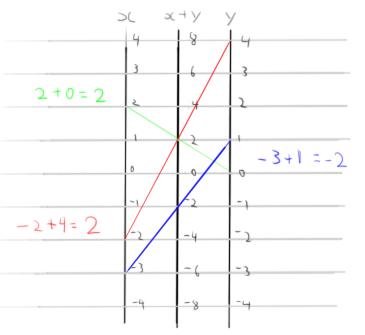 From this simple beginning, it's possible to make other analog computation devices that are much more sophisticated. By using logarithmic axes, you can perform multiplication, since log(x) + log(y) = log(xy).
Nomograms are rather outdated, now that computers can perform numerical calculations much more easily and with far greater accuracy than anyone can measure by hand. The reason I'm looking into nomograms again is because they can be distributed on paper more easily than a computer program, they are relatively intuitive, and they allow very complex systems of equations to be solved by people who don't know math. There are also some iGEM outreach events coming up...
 ...so we'd like to be able to show people mathematical modelling stuff that's related to synthetic biology, but it's hard to come up with stuff that's interesting, learnable in minutes, and true. I think it's possible to condense some tricky work into a graph:
The above graph shows a setup that could calculate the concentration of a molecule and its isomers given a reaction rate constant (provided the axes were properly scaled). This is a fair amount of work (for the creator of the nomogram) when you could just plug "exp(-k*t)" into a calculator, but it's hard to beat the connect-the-dots simplicity of a nomograph. The other nice thing about this type of graph is that it really emphasizes the fact that it's easy to 'cheat' and start with the desired final answer and work backwards to get inputs... ie, design the system analytically.
Unfortunately, the irreversible isomerization reaction is still rather lame and even with an easy method of calculating it, it's still not particularly exciting. What would be cool would be to get a system of equations that describes an optimization problem and have a graph visually represent design trade-offs (like the triangular graph on this page), but that sounds like it might be too ambitious for me to tackle in a couple of spare hours.
Thursday, October 7, 2010
Context-free grammar (Part 1 of 2)
 What are context-free grammars? An abstract definition might say that they're a set of rules allowing for the construction of complex structures consisting of logical parts that can be arbitrarily nested, but I've found that nobody really likes my abstract definitions, so I'll try using an analogy instead.
Consider a freight train hauling three containers (containers A, B, and C):
 Let's say that container A can only contain livestock, container B transports liquids, and container C contains manufactured goods. It doesn't matter what type of livestock, liquids, and manufactured goods are transported so long as they fit into their respective categories.
We have just defined a very simple grammar. Within this structure, it is possible to have 'phrases' such as "pigs milk computers" or "cows mercury needles".
 A cow-mercury-needle train and pig-milk-computer train collision would be unfortunate.
Both the cow-mercury-needle train and the pig-milk-computer train are examples of the same model of train — an A-B-C train — that happen to be carrying different items in their identical containers. The model of the train can be thought of as one rule (or phrase structure) in the grammar, but it is certainly possible to have other rules.
The analogy gets a bit weird here (yes, weirder than the above image) because context free grammars also allow their containers to contain other trains.
Let's imagine a different model of train, the B-A-Weird train that has a B-container (which must, as before, contain a liquid), an A-container (holding livestock) and a weird container which holds either an A-B-C train or a B-A-Weird train. Now instead of a pig-milk-computer train, it would be possible to have a milk-pig-cow-mercury-needle train where the milk is in compartment B, the pigs are in compartment A and the cow-mercury-needle train from above is all in the weird compartment.
Okay, that's pretty weird, but that's not nearly as strange as being able to put a B-A-Weird train inside the Weird compartment. This could allow us to take the entire train we just discussed and stick it in the last compartment of another B-A-Weird train. Then we could take that train and do the same thing, over and over, as much as we would like. However, at this point the train analogy has lost almost all meaning and is likely confusing matters substantially.
Fortunately, there is a familiar application for context-free grammars that should make more sense now, namely language. By specifying containers in terms of parts of speech instead of cargo, we can construct sentences instead of trains. This is sort of reminiscent of Mad Libs: "the {noun} {past tense verb}
As before though, things get interesting when sentence structures get put inside of other sentence structures (just as trains... get... er, put inside of other trains). We can expand the definition of nouns to include phrases in the structure "
There is a slight problem with this setup in that, as before, things get complicated when structures are continually placed inside other structures. The phrase
"The dog the boy the man the hamster ate raised owned bit the boy the man the hamster ate raised."is in fact valid using the two rules defined above and can be parsed as:
The (dog the (boy the (man the (hamster) ate) raised) owned) bit the (boy the (man the (hamster) ate) raised)....meaning the hamster ate the man who raised the boy who owned the dog which bit the boy raised by the man eaten by the hamster.
So... yeah, people don't generally speak like that because of cognitive limits to how many nested levels of information we can keep track of at once. But maybe, you say, this idea of context-free grammar could still be useful for creating different kinds of structure. Some sort of really complex structure that can have parts embedded in other parts in ways that are hard for people to imagine. Perhaps, you hazard, some sort of biological structure.
In this last set of thoughts, you've outlined the general idea behind GenoCAD, a context-free grammar for synthetic biology. It seems to be a good fit at first but, as Andre from the UW iGEM team points out, there are quite a few properties of DNA sequences that it fails to capture. More on this later.
Wednesday, September 15, 2010
Hand-Eye Impairment

I had a conversation about piano playing with one of the other guys in my house recently. I had been practicing on my keyboard and he admitted that he used to take lessons himself. As most people do, he downplayed his current ability, but I found it interesting that he did this by saying that he used to always memorize pieces so that he could look at his hands (and therefore never really picked up sight-reading).
I've always hated memorizing music and am actually quite dependent on having a piece of paper in front of me. This is frustrating when I'm near someone else's piano (or my own, without music) and someone asks me to play something. Most piano players would just start playing some song they learned when they were ten, but I really don't remember what I've played before. Perhaps more importantly, having to read the music off a page all the time means I have to spend a lot of effort concentrating on reading that could be better used on technique, or artistry, or listening to what I'm playing instead of just playing it.
So with the goal of memorizing some pieces and with the earlier conversation in mind, I tried playing some pieces while looking at my hands instead of the page. It turns out, I really can't do it. In fact, I am far less capable of playing the piano while looking at my hands then I am when I look away entirely or close my eyes. It seems that looking at my hands move prevents me from being able to use them normally, like my brain's not able to cope with the strange new visual feedback that comes from actually watching what I'm doing.
I find this interesting, as it took many long years of conditioning not to look at my hands while playing and it would appear that that conditioning goes pretty deep. Now to go and work on undoing that work...
Sunday, September 12, 2010
Videos, by JoVE!
This post is nothing more than a link to the journal of visualized experiments, because there's really no reason you should be reading my ramblings when you could be watching science.
It's like a Discovery Channel show, except far more specialized, technical, and current.
Also, if you watch the first few seconds of a clip and then are frustrated when it asks for a subscription, you are probably not using the University of Waterloo's network at the moment. If that is the case but you are still a Waterloo student/faculty, do the following: go to lib.uwaterloo.ca and click the connect from home link (or just click the connect from home link in this post, that will work as well), then login and go to http://www.jove.com.proxy.lib.uwaterloo.ca. If that doesn't work, then just do a search for the journal of visualized experiments after logging into the proxy. This is fully worthwhile, really.
It's like a Discovery Channel show, except far more specialized, technical, and current.
Also, if you watch the first few seconds of a clip and then are frustrated when it asks for a subscription, you are probably not using the University of Waterloo's network at the moment. If that is the case but you are still a Waterloo student/faculty, do the following: go to lib.uwaterloo.ca and click the connect from home link (or just click the connect from home link in this post, that will work as well), then login and go to http://www.jove.com.proxy.lib.uwaterloo.ca. If that doesn't work, then just do a search for the journal of visualized experiments after logging into the proxy. This is fully worthwhile, really.
Friday, June 4, 2010
Let's All Learn About iGEM Software! Yay!
This is one of those posts I wrote for my own benefit, not some hypothetical readership. This will likely be apparent. You have been warned.
I was originally planning on writing about something else and including my standard doodle with this post, but my Google search for reference images seriously grossed me out and I don't have time for that. Instead, here's a post about iGEM software which will force me to do some useful research instead of looking up eye-rending images on Google. Yay!
If you don't know me and are new to this blog here are some explanatory links about iGEM. With that out of the way, what's up with this year's Waterloo iGEM software project? Well, we're working with a BioCompiler concept that roughly translates to: take code, apply genius, extract BioBrick assembly instructions. A compiler, in a computational context, takes code and translates it into equivalent code in a much more primitive language and what we intend to do is an exact analogy of that process for biological systems.
We haven't gotten very far with this design yet, but already there seems to be a canonical example of the goal in the form of the pseudocode "if the concentration of (something) exceeds (value) and the concentration of (something else) is less than (another value) then produce [something]". I wonder how much complexity would be involved in simply translating specifications that meet the above template into assembly instructions; intuitively, I don't feel it should be too excessive, but there is already some possibility for conflicts between the signalling pathway of "something" versus "something else" and this system would already probably be pretty tricky to construct. Following this vague syntax, our working design for the main 2010 project would fit the template "if (something) is present, produce (something else); if the concentration of (something else) is above (constant), produce (yet another thing)". That's an almost trivial piece of code, but it's already pushing the limits of what we can model and what we can construct. Whether this a ringing endorsement of the BioCompiler concept or an outright condemnation, I'm not sure.
The BioCompiler concept is both really exciting and worrisome at the same time. Worrisome, because in order to pursue the BioCompiler idea we'll be discarding work done by the software team of the previous term which sets a bad precedent for continuity. Moreover, this project will definitely not be done before the end of the term, so we'll need to depend on the software team from the opposing stream to continue it. On top of the "sorry I killed you project" factor, it also bugs me that this isn't a project I could conceivably sit down and write myself given a couple weeks. I mean, I realize that it's a good thing that we have an ambitious project that will involve more than myself, and I never had any intention of literally writing the whole software project by myself, but at the same time I like being able to deliver tangible results and this project has no guarantees of delivering those results any time soon. Nonetheless, optimism run high.
Okay. That was all a long diversion because the point of this post was for me to force myself to read and talk about UC Berkeley's 2009 software project. Their project had four main components, all of which are helpfully embodied by silly characters in their documentation. Eugene, the "red-headed stepchild and language", is a formal way of describing BioBrick components. His glasses, Spectacles, are (represents? is? this is where the anthropomorphization of the software modules becomes frustrating linguistically) a tool for visualizing Eugene's data. Kepler is a "Wise Astronomer and Workflow Wizard" which is to say that it's the part of the project concerned with the assembly of parts and it/he actually guides a robot through the assembly process. That was bold and italic because it's that mindblowing. Finally, Clotho (AKA the Hot Green Chick) is a "Greek Goddess and Software Tool". Say what you will about Berkeley's documentation, at least it's memorable (and actually the rest of their documentation is decent as well, including design notes from team members and demo videos of some of the software products).
Anyway, Clotho, yeah. Clotho is an attempt to span the design hierarchy between the parts-level design that Kepler, Eugene, and Spectacles work at and the systems-level and device-level design that engineers like to think at. Actually, upon re-reading the Berkeley page, it appears they believe Kepler, Eugene, and Spectacles operate at the device-level. Huh. It also appears that despite lofty aims at hierarchy-spanning behaviour from Clotho, that module is a simple data management system. It might help you organize your thoughts at varying levels of abstraction, but it certainly won't take ideas written at one level and push them to another. That, I guess, is where we come in.
Alright folks, I'm falling asleep so this is as far as we come today. If you've read this far, I... well I don't know what to think. I'm assuming you haven't read this far. Maybe you cheated and skimmed to the end. In any case, thanks for bearing through it and hopefully everyone learned a valuable lesson about iGEM software. Yay!
I was originally planning on writing about something else and including my standard doodle with this post, but my Google search for reference images seriously grossed me out and I don't have time for that. Instead, here's a post about iGEM software which will force me to do some useful research instead of looking up eye-rending images on Google. Yay!
If you don't know me and are new to this blog here are some explanatory links about iGEM. With that out of the way, what's up with this year's Waterloo iGEM software project? Well, we're working with a BioCompiler concept that roughly translates to: take code, apply genius, extract BioBrick assembly instructions. A compiler, in a computational context, takes code and translates it into equivalent code in a much more primitive language and what we intend to do is an exact analogy of that process for biological systems.
We haven't gotten very far with this design yet, but already there seems to be a canonical example of the goal in the form of the pseudocode "if the concentration of (something) exceeds (value) and the concentration of (something else) is less than (another value) then produce [something]". I wonder how much complexity would be involved in simply translating specifications that meet the above template into assembly instructions; intuitively, I don't feel it should be too excessive, but there is already some possibility for conflicts between the signalling pathway of "something" versus "something else" and this system would already probably be pretty tricky to construct. Following this vague syntax, our working design for the main 2010 project would fit the template "if (something) is present, produce (something else); if the concentration of (something else) is above (constant), produce (yet another thing)". That's an almost trivial piece of code, but it's already pushing the limits of what we can model and what we can construct. Whether this a ringing endorsement of the BioCompiler concept or an outright condemnation, I'm not sure.
The BioCompiler concept is both really exciting and worrisome at the same time. Worrisome, because in order to pursue the BioCompiler idea we'll be discarding work done by the software team of the previous term which sets a bad precedent for continuity. Moreover, this project will definitely not be done before the end of the term, so we'll need to depend on the software team from the opposing stream to continue it. On top of the "sorry I killed you project" factor, it also bugs me that this isn't a project I could conceivably sit down and write myself given a couple weeks. I mean, I realize that it's a good thing that we have an ambitious project that will involve more than myself, and I never had any intention of literally writing the whole software project by myself, but at the same time I like being able to deliver tangible results and this project has no guarantees of delivering those results any time soon. Nonetheless, optimism run high.
Okay. That was all a long diversion because the point of this post was for me to force myself to read and talk about UC Berkeley's 2009 software project. Their project had four main components, all of which are helpfully embodied by silly characters in their documentation. Eugene, the "red-headed stepchild and language", is a formal way of describing BioBrick components. His glasses, Spectacles, are (represents? is? this is where the anthropomorphization of the software modules becomes frustrating linguistically) a tool for visualizing Eugene's data. Kepler is a "Wise Astronomer and Workflow Wizard" which is to say that it's the part of the project concerned with the assembly of parts and it/he actually guides a robot through the assembly process. That was bold and italic because it's that mindblowing. Finally, Clotho (AKA the Hot Green Chick) is a "Greek Goddess and Software Tool". Say what you will about Berkeley's documentation, at least it's memorable (and actually the rest of their documentation is decent as well, including design notes from team members and demo videos of some of the software products).
Anyway, Clotho, yeah. Clotho is an attempt to span the design hierarchy between the parts-level design that Kepler, Eugene, and Spectacles work at and the systems-level and device-level design that engineers like to think at. Actually, upon re-reading the Berkeley page, it appears they believe Kepler, Eugene, and Spectacles operate at the device-level. Huh. It also appears that despite lofty aims at hierarchy-spanning behaviour from Clotho, that module is a simple data management system. It might help you organize your thoughts at varying levels of abstraction, but it certainly won't take ideas written at one level and push them to another. That, I guess, is where we come in.
Alright folks, I'm falling asleep so this is as far as we come today. If you've read this far, I... well I don't know what to think. I'm assuming you haven't read this far. Maybe you cheated and skimmed to the end. In any case, thanks for bearing through it and hopefully everyone learned a valuable lesson about iGEM software. Yay!
Wednesday, November 25, 2009
Lockhart's Lament
This article on K12 math education was written in 2002, but it finally found its way onto my class's Google group in the past couple days: http://plato.asu.edu/LockhartsLament.pdf
Before you dash off to read it, I should note that there are a couple big flaws with the argument. The main one is that he claims that math is useless and that this is a good thing. Math is not useless and it would not be a good thing if it were. Further arguments are below, but you can go read the article first.
--- Waiting. Go read the article. ---
Okay. You've read it? Here we go...
FURTHER ARGUMENTS
Lockhart's stance that math is art and thus useless (but capable of, you know, enlightening people...) does a disservice to both artists and mathematicians. Sure, art can be done for art's sake, but good art is done because people (even people who are not the artists themselves!) like it and it is thus useful.
Indeed, Lockhart's view of art reminds me a lot of List A pieces from the Royal Conservatory of Music. These are the classical, historic masterpieces that are critically acclaimed and all that [lack of] jazz, but are dead boring to a lot of modern students, such as myself. Music, art, and math do not exist in a vacuum. They are made better by being applied to the real world, to real situations, and to real problems.
Lockhart asserts that trigonometry is useless to most people's lives; this is clearly for lack of trying. Trigonometric functions provide a basis for the analysis of all periodic systems, from electrical circuits, to mechanical oscillators, many biological processes, and so forth. Can the beauty of the periodicity of a periodic function be appreciated without realizing this? Sure, maybe, for some people who would undoubtedly make fine mathematicians. There are, however, many cases where math is not developed for its beauty, but for its practical application. Take the Dirac delta function: a vertical spike at the origin of infinite height but with area one. Does that sound beautiful? (Okay, honestly, it does to me, but that's mainly because I've read ahead.) It's hard to imagine someone coming up with the impulse function for purely aesthetic reasons — as it goes against pretty much everything math has to say about functions — but it turns out to be extremely useful (I mean, man, you have know idea how important this one concept is, seriously, yow) for signal processing and the design of linear-time invariant systems (ie. not quite everything, but a large subset of everything).
The point that I want to make though is that the art metaphor is not flawed, but Lockhart annoyingly neglects the idea of pop art (stuff that people can actually relate to) for stuffy avant-garde postmodern cruft that can supposedly be admired for its intrinsic celestial beauty. Art is only art because it has context; math is only math because it is grounded in applications. To paraphrase Lady Gaga, pop culture will never be lowbrow.
Thanks for reading!
P.S. For those of you who have noticed that I drop a lot more Lady Gaga references now than I did before, it's because I need an excuse to link to this video which is awesome. I don't care what you think of dance pop, if you can play the piano with your foot that is damned impressive.
Before you dash off to read it, I should note that there are a couple big flaws with the argument. The main one is that he claims that math is useless and that this is a good thing. Math is not useless and it would not be a good thing if it were. Further arguments are below, but you can go read the article first.
--- Waiting. Go read the article. ---
Okay. You've read it? Here we go...
FURTHER ARGUMENTS
Lockhart's stance that math is art and thus useless (but capable of, you know, enlightening people...) does a disservice to both artists and mathematicians. Sure, art can be done for art's sake, but good art is done because people (even people who are not the artists themselves!) like it and it is thus useful.
Indeed, Lockhart's view of art reminds me a lot of List A pieces from the Royal Conservatory of Music. These are the classical, historic masterpieces that are critically acclaimed and all that [lack of] jazz, but are dead boring to a lot of modern students, such as myself. Music, art, and math do not exist in a vacuum. They are made better by being applied to the real world, to real situations, and to real problems.
Lockhart asserts that trigonometry is useless to most people's lives; this is clearly for lack of trying. Trigonometric functions provide a basis for the analysis of all periodic systems, from electrical circuits, to mechanical oscillators, many biological processes, and so forth. Can the beauty of the periodicity of a periodic function be appreciated without realizing this? Sure, maybe, for some people who would undoubtedly make fine mathematicians. There are, however, many cases where math is not developed for its beauty, but for its practical application. Take the Dirac delta function: a vertical spike at the origin of infinite height but with area one. Does that sound beautiful? (Okay, honestly, it does to me, but that's mainly because I've read ahead.) It's hard to imagine someone coming up with the impulse function for purely aesthetic reasons — as it goes against pretty much everything math has to say about functions — but it turns out to be extremely useful (I mean, man, you have know idea how important this one concept is, seriously, yow) for signal processing and the design of linear-time invariant systems (ie. not quite everything, but a large subset of everything).
The point that I want to make though is that the art metaphor is not flawed, but Lockhart annoyingly neglects the idea of pop art (stuff that people can actually relate to) for stuffy avant-garde postmodern cruft that can supposedly be admired for its intrinsic celestial beauty. Art is only art because it has context; math is only math because it is grounded in applications. To paraphrase Lady Gaga, pop culture will never be lowbrow.
Thanks for reading!
P.S. For those of you who have noticed that I drop a lot more Lady Gaga references now than I did before, it's because I need an excuse to link to this video which is awesome. I don't care what you think of dance pop, if you can play the piano with your foot that is damned impressive.
Wednesday, September 23, 2009
You Don't Know Slow
 Driving below the posted speed limit is not slow. The pace of the "Fellowship of the Ring" book was not slow. A snail dragging a brick is not slow.
Then what is slow, you ask, if not these things? A computer program to simulate all possible recombinations of a couple strands of DNA, is what. Specifically, the current implementation of the Recombinatron project I've previously posted about.
We've known for a while that the program was slow. There was talk of "factorial run-time" and "exponential growth" but we didn't really pay that much attention to these things. Time's too short to waste it figuring out Big O notation when you could instead just run the program.
On a computer with 12 GB of memory.
And wait eight hours as the program stalls on step 4 of 255.
...
...
...
It turns out the program's pretty slow. Not "man, FancyApp 2.0 sure is slow" slow, but "man, this won't even be halfway done before the sun dies" slow.
Monday, September 21, 2009
Seriously?
 This is depressing for a few reasons:
- This is a fairly accurate copy of part of my Signals and Systems work.
- All the comments were written by me. Talking to myself. On paper.
- The math in it is pretty easy.
Wednesday, September 2, 2009
Playing with Transformers
 I'm on vacation now. Naturally, this means that I no longer have to program, or do circuits labs, or build cardboard bridges. Equally naturally, I'm hoping to get some programming for iGEM done and maybe start a woodworking project and play with electrical stuff...
It was while playing with electrical stuff recently that I found out just how little I actually recalled from my class in Electricity, Magnetism, and Optics (EMO). I mean really, how hard can it be to hook up a fluorescent light? (Answer: if you don't have the ballast, good luck with that.) Even making LED circuits involves a surprising amount of calculation which, engineering student that I am, I immediately delegated to an online designer.
My dad also keeps a box full of random parts salvaged from various radios and computers. This is pretty cool. The box had a few transformers in it, so we decided to test one by hooking a battery up to one end and a multimeter to the output wires to see what we obtained as output voltage. At this point, the electrical engineers reading this (and who have seen the image at the top of this post) can probably guess what happened.
Nothing happened. At least not at first: we had connected the battery, then I connected the multimeter probes, holding them to the output wires of the transformer with my fingers. My dad then removed the battery, and I jumped out of my skin. Fortunately, even with the transformer, the shock from the AA batery was far from deadly.
So what happened here? Why, and this is becoming something of a theme on this blog, am I such an idiot?
The thing is, transformers are meant to be used with alternating current (AC) and not direct current. The reason for this is pretty simple: the transformer consists of two coils of wires which are, as wikipedia says, inductively coupled. And, as I should have known, the induced voltage in an inductor is proportional to the rate of change of the magnetic flux through it. With the battery attached, there was no change in current, therefore no change in magnetic flux and no electrocution. Remove the battery, however, and things do change.
There's nothing quite like a light shocking to act as a remedial science lesson.
Wednesday, July 22, 2009
(Text)book Review : Signals & Systems (2nd Ed)
I've been looking forward to taking Systems & Signals for a while now, so when the official textbook for this year was announced (surprise! it's the same as last year's again), I went and picked one up.
And yes, I know it's a bit weird to get textbooks over a month before the term starts. And I realize that I probably won't get all that far before the term starts. And I realize that the promised 'review' in the post title will be weakened slightly by the fact that I haven't yet read the book.
But I think there's some value in giving my impressions of the textbook now, before the long and presumably difficult term that is to come goes and spoils my appreciation of it. Or maybe this will help someone deciding whether or not to buy this book at all. Or maybe I'm just crazy. Regardless, I've stalled enough, so on to the review...
The first thing you'll notice with this textbook is that it's remarkably plain. Gone is the translucent periodic table inserted into the chemistry text, gone is the lovely layout design of Linear Algebra and Applications, gone is the marketing spiel, the learning aids and the motivational pictures of Fundamentals of Physics.
It is, in short, not a first year textbook. There is nothing about it really that makes you want to buy it, or feel good about having bought it, or waste your little attention on it. By this point, the makers of this textbook know, you're damn well going to buy the textbook. The alternative, after all, is to flirt with failure and the chance to buy the textbook the second time around.
I'll admit to not being overly impressed with my initial glance through the book, but first impressions aren't everything and, as much as I like textbooks that will compete for my attention, it's really more important that they cover interesting material.
So what material does S&S cover? From the table of contents...
Recommendation : If you're not particularly interested by signals or systems you'll probably be slaughtered by this course anyway, but I would suggest getting the book. It's an old edition so you can pick it up second hand and it could be handy if you ever need to brush up on fancy signal transformation stuff before a job interview.
If you do like systems and signals, then this should be a pretty easy decision. Unless of course, you're really into them, in which case maybe you have a shelf full of signal processing books already.
And yes, I know it's a bit weird to get textbooks over a month before the term starts. And I realize that I probably won't get all that far before the term starts. And I realize that the promised 'review' in the post title will be weakened slightly by the fact that I haven't yet read the book.
But I think there's some value in giving my impressions of the textbook now, before the long and presumably difficult term that is to come goes and spoils my appreciation of it. Or maybe this will help someone deciding whether or not to buy this book at all. Or maybe I'm just crazy. Regardless, I've stalled enough, so on to the review...
The first thing you'll notice with this textbook is that it's remarkably plain. Gone is the translucent periodic table inserted into the chemistry text, gone is the lovely layout design of Linear Algebra and Applications, gone is the marketing spiel, the learning aids and the motivational pictures of Fundamentals of Physics.
It is, in short, not a first year textbook. There is nothing about it really that makes you want to buy it, or feel good about having bought it, or waste your little attention on it. By this point, the makers of this textbook know, you're damn well going to buy the textbook. The alternative, after all, is to flirt with failure and the chance to buy the textbook the second time around.
I'll admit to not being overly impressed with my initial glance through the book, but first impressions aren't everything and, as much as I like textbooks that will compete for my attention, it's really more important that they cover interesting material.
So what material does S&S cover? From the table of contents...
- Signals and Systems (duh)
- Linear Time-Invariant Systems
- Fourier Series Representation of Periodic Signals
- The Continuous-Time Fourier Transform
- The Discrete-Time Fourier Transform
- Time and Frequency Characterization of Signals and Systems
- Sampling
- Communication Systems
- The Laplace Transform
- The Z-Transform
- Linear Feedback Systems
Recommendation : If you're not particularly interested by signals or systems you'll probably be slaughtered by this course anyway, but I would suggest getting the book. It's an old edition so you can pick it up second hand and it could be handy if you ever need to brush up on fancy signal transformation stuff before a job interview.
If you do like systems and signals, then this should be a pretty easy decision. Unless of course, you're really into them, in which case maybe you have a shelf full of signal processing books already.
Sunday, July 5, 2009
So it's 3 am right now...
 Sleep deprivation. It's an important topic. Just go to the Wikipedia page on the topic and you'll find some supposed effects of it that are frightening enough to keep you awake for a while.
Yet sleep deprivation is basically a fact of life for university students. For some, it's a point of honor to stay up late (this usually goes with the mantra "sleep is for the weak"). Others are pressured into staying up to finish assignments, cram for tests, or play World of Warcraft. But the fact remains, you cannot function well when tired. In fact, I don't think I can finish this blog post right now. Seriously, I can't do it... come back in ten hours and this post will be jaw-droppingly good. I'm going to bed.
<------- Nine and a Half Hours Pass ------->
Okay, so what did we just learn here? Other than I've lost the ability to stay up late in my old age?
Things become harder when you're tired. Assignments that should take two hours under normal conditions can suddenly take fourteen hours to complete (I have fairly reliable sources that indicate that this has really happened, but not to me personally... my record is about eight hours).
Can sleep deprivation ever help get things done? I think that most students have experienced a late-night essay writing binge at one point that felt remarkably productive. This is usually attributed to last-minute pressure providing motivation to work. You'll note though, that you only get that feeling with projects that have subjective marking schemes: math assignments never get easier with "last minute pressure."
I'm going to throw a wild conjecture out there: when you're able to write an essay quickly at three in the morning, it's not because of last minute pressure. No, it's simply a case of your standards dropping to the point where you become more focused on finishing the essay that doing it well.
"But," you say, "I got really good marks on all the essays I wrote at 4 a.m. the day before they were due!"
I don't doubt that this is possible, because I've also done remarkably well with essays written in the witching hour. There are times when you need to stop overthinking everything and just start writing, and if too much thinking is the problem, sleep deprivation can certainly cure that.
Sunday, May 31, 2009
Helvetica is Expensive
Stung by criticism from xckd and college humor videos about my choice in fonts, I decided briefly to try out this whole 'Helvetica' craze. It turns out though, that that's not included with Word. But hey - no problem - I'll just load up Firefox and download it! Right?
It turns out, as you may have guessed from the title of this post, that you have to pay for that privilege. 43 Canadian dollars will get you one set of characters. If you want that in bold and italic (or bold and italic, or a few other basic variations) it could run you a couple hundred. And if you wanted the full pack, with the international characters, accents, font weights, rounded edges and whatnot it costs about nine hundred dollars. Nine hundred dollars.
Not that I begrudge Linotype for profiting off this font. They did after all put in a lot of serious design work into those letters fifty years ago and they should be rewarded for that. And they are undoubtedly trying to keep the unwashed masses away from the font, which is supposedly overused already. But still: nine hundred? I'm sorry blog readers, but you're just going to have to put up with Times New Roman and Arial (that's close to Helvetica, right? Oh fine, no Arial).
It turns out, as you may have guessed from the title of this post, that you have to pay for that privilege. 43 Canadian dollars will get you one set of characters. If you want that in bold and italic (or bold and italic, or a few other basic variations) it could run you a couple hundred. And if you wanted the full pack, with the international characters, accents, font weights, rounded edges and whatnot it costs about nine hundred dollars. Nine hundred dollars.
Not that I begrudge Linotype for profiting off this font. They did after all put in a lot of serious design work into those letters fifty years ago and they should be rewarded for that. And they are undoubtedly trying to keep the unwashed masses away from the font, which is supposedly overused already. But still: nine hundred? I'm sorry blog readers, but you're just going to have to put up with Times New Roman and Arial (that's close to Helvetica, right? Oh fine, no Arial).
Tuesday, May 19, 2009
BIG FISH
The BBC has a cool photo of a really big fish today. It's really, really big.
Meanwhile, on campus, it looks like Stephen Hawking might not be able to give a guest lecture in town after all due to his health problems, which would be most unfortunate. However, I was looking at the archives of previous lecturers and we've had some pretty impressive people speak here. Amongst them: Roger Penrose (of Penrose tiling fame), Leonard Mlodinow (physicist and author of The Drunkard's Walk and Feynman's Rainbow), and Jay Ingram (my idol).
Meanwhile, on campus, it looks like Stephen Hawking might not be able to give a guest lecture in town after all due to his health problems, which would be most unfortunate. However, I was looking at the archives of previous lecturers and we've had some pretty impressive people speak here. Amongst them: Roger Penrose (of Penrose tiling fame), Leonard Mlodinow (physicist and author of The Drunkard's Walk and Feynman's Rainbow), and Jay Ingram (my idol).
Saturday, April 11, 2009
Study Spots
 (click image to enlarge)
I move around a lot when I study. It's an ongoing quest of sorts to find the perfect study spot where you can relax in comfortable surroundings (possibly outside) with a nice desk (maybe some air conditioning) and access to a computer. Ideal study spots should be out of the way so that you can have a nice solitary working environment, but not so out of the way that you can never see the Sun if you have to stay there for a few days; they should also be comfy (as mentioned above) but no so much so that you end up falling asleep in your textbook.
P.S. The lighting and a bunch of other stuff in the picture in this post isn't all that well done. However, I'm really tired and have a bunch of exams soon.
Saturday, April 4, 2009
Bands, Blue Men, Bridges, and Balls of Toilet Paper
A lot of stuff has happened since I last wrote here, so this post will be an interestingly funky hodgepodge of stuff (hopefully).
First up: I just got back from an end of charity gig I was playing at with the engineering jazz band. It was pretty rocking, if I do say so myself. I'm also listening to a Blue Man Group CD while writing this, so I'm definitely riding on a bit of a music high at the moment. The Blue Man Group album (The Complex) is also really good, so I'm not really paying attention to what I'm writing. I apologize for this.
Second: The final project of my Mechanics of Deformable Solids course (which shall be referred to henceforth as 'MoDS') was to build a bridge out of cardboard (well, millboard, technically). We tested the bridges this week, which was a lot of fun because (a) it helped satisfy everyone's natural need for watching things break, (b) some of the failure's were pretty cool examples of shear deformation as the bridges slowly contorted around weak points, and (c) my group did well, supporting five hundred pounds with our 0.96 kg bridge bridge and getting within ten pounds of our predicted failure load. Granted a 1:250 weight to strength ratio is not unbelievable, as there was a group that supported over seven hundred pounds (and the all time record is rumoured to be over a thousand), but it's always nice to see stuff work the way you expect it to.
And last up: the balls of toilet paper. Yes sir. This one needs some explaining...
You see, on the day of the bridge testing, it also happened to be April Fool's Day and naturally, in our houseful of engineers we wished to celebrate the occasion. Naturally, with a Costco-sized supply of toilet paper available, the thought of strewing paper around ('TP'-ing) one of housemate's rooms was suggested, but, nice people that we are, we decided that was too messy / unoriginal / difficult to clean up. Then the classic idea of gluing all his furniture to the ceiling (using glue leftover from the bridge project) was floated -- again though, too evil.
Then genius struck.
We'd leave the toilet paper rolls in their plastic packaging and tape them, and other small items lying around, to the walls and ceiling. It was simple, clean, surreal, visually interesting, and (at least in our own eyes) a work of art.
You wouldn't think that this plan would be very hard to carry out for a couple of guys who just built a bridge a gorilla could walk over out of cardboard... but it turns out that scotch tape doesn't adhere well to the ceiling and it was having a lot trouble supporting the weight of the toilet paper rolls. The prank was turning out to be on us as the few rolls that were able to briefly stick to the ceiling came pelting down onto our heads after a few minutes. Lesson learned: use masking tape; it's much more effective.
So finally all the toilet was stuck up, with a water bottle and kleenex box strung up for good measure, and we built a little pyramid out of the remaining toilet paper and rubber ducks to fit in the doorway. The whole thing went over with my other housemate pretty well, although we quickly discovered that toilet paper balls made good projectile weapons in the same way that nerf balls do (because they have enough weight to be tossed, yet still don't hurt). After this discovery, we spent a bit more time exploring the possibilities it created (read: all out toilet paper warfare) before cleaning things up (all right, technically, we haven't gotten to the cleaning part yet).
I could go on, but I'd rather go and sing along to some songs on my computer.
If I sing a song / Will you sing along / Well I keep on singing right here by myself... ba dow dow dow bow dow dow dow, ba dow dow dow ba dow...
[Edit: For anyone concerned that with all the above shenanigans, I'm not studying / writing about studying enough, let me add that as of last Tuesday, my last 'midterm' was over, and as of Friday classes are done for the term. So yes, much studying will ensue over the next month as exams hit, but that won't stop us from having our exams and toilet paper too.]
First up: I just got back from an end of charity gig I was playing at with the engineering jazz band. It was pretty rocking, if I do say so myself. I'm also listening to a Blue Man Group CD while writing this, so I'm definitely riding on a bit of a music high at the moment. The Blue Man Group album (The Complex) is also really good, so I'm not really paying attention to what I'm writing. I apologize for this.
Second: The final project of my Mechanics of Deformable Solids course (which shall be referred to henceforth as 'MoDS') was to build a bridge out of cardboard (well, millboard, technically). We tested the bridges this week, which was a lot of fun because (a) it helped satisfy everyone's natural need for watching things break, (b) some of the failure's were pretty cool examples of shear deformation as the bridges slowly contorted around weak points, and (c) my group did well, supporting five hundred pounds with our 0.96 kg bridge bridge and getting within ten pounds of our predicted failure load. Granted a 1:250 weight to strength ratio is not unbelievable, as there was a group that supported over seven hundred pounds (and the all time record is rumoured to be over a thousand), but it's always nice to see stuff work the way you expect it to.
And last up: the balls of toilet paper. Yes sir. This one needs some explaining...
You see, on the day of the bridge testing, it also happened to be April Fool's Day and naturally, in our houseful of engineers we wished to celebrate the occasion. Naturally, with a Costco-sized supply of toilet paper available, the thought of strewing paper around ('TP'-ing) one of housemate's rooms was suggested, but, nice people that we are, we decided that was too messy / unoriginal / difficult to clean up. Then the classic idea of gluing all his furniture to the ceiling (using glue leftover from the bridge project) was floated -- again though, too evil.
Then genius struck.
We'd leave the toilet paper rolls in their plastic packaging and tape them, and other small items lying around, to the walls and ceiling. It was simple, clean, surreal, visually interesting, and (at least in our own eyes) a work of art.
You wouldn't think that this plan would be very hard to carry out for a couple of guys who just built a bridge a gorilla could walk over out of cardboard... but it turns out that scotch tape doesn't adhere well to the ceiling and it was having a lot trouble supporting the weight of the toilet paper rolls. The prank was turning out to be on us as the few rolls that were able to briefly stick to the ceiling came pelting down onto our heads after a few minutes. Lesson learned: use masking tape; it's much more effective.
So finally all the toilet was stuck up, with a water bottle and kleenex box strung up for good measure, and we built a little pyramid out of the remaining toilet paper and rubber ducks to fit in the doorway. The whole thing went over with my other housemate pretty well, although we quickly discovered that toilet paper balls made good projectile weapons in the same way that nerf balls do (because they have enough weight to be tossed, yet still don't hurt). After this discovery, we spent a bit more time exploring the possibilities it created (read: all out toilet paper warfare) before cleaning things up (all right, technically, we haven't gotten to the cleaning part yet).
I could go on, but I'd rather go and sing along to some songs on my computer.
If I sing a song / Will you sing along / Well I keep on singing right here by myself... ba dow dow dow bow dow dow dow, ba dow dow dow ba dow...
[Edit: For anyone concerned that with all the above shenanigans, I'm not studying / writing about studying enough, let me add that as of last Tuesday, my last 'midterm' was over, and as of Friday classes are done for the term. So yes, much studying will ensue over the next month as exams hit, but that won't stop us from having our exams and toilet paper too.]
Tuesday, March 10, 2009
How to Buy an Airline Ticket
Well, I can finally say I've attended an MIT lecture. Dr. Belobaba from MIT's International Center for Air Transportation (ICAT) dropped by today to give a guest lecture on the topic of airline pricing schemes and revenue management.
It was an interesting talk that did a good job of explaining why airlines feel the need to have multiple fares for the same flight and to sell tickets at different prices depending on when they're bought.
Basically, airlines want to sell as many high-priced tickets as possible, but they know that there are a lot of people who will only fly at lower costs, hence the need for differential pricing. Then of course, the people who were willing to pay more won't be quite as happy to part with their money if they know that someone else is getting the same service for the same price, which is why airlines introduced restrictions on low fare tickets including "Saturday night stay" conditions that prevent the type of quick round-trips that businesses require.
But on top of these differential pricing schemes, the airlines also use revenue management. That is, they reserve a certain number of the more expensive tickets based on statistical models for how many they believe they'll be able to sell. This is sensible enough, because if they know that they will eventually sell out a given number number of expensive tickets, they don't want those seats going to starving students who will only pay the cheap rate. Of course, they don't know how many tickets they'll be able to sell exactly, so that's where the probability comes in.
Technically, you look at the expected value of some probability function to do this, but all that means is that the cutoff for reserving a ticket of a certain class is the point at which you get the same number by multiplying the ticket's price by its probability of being sold as you do when you multiply the price of a cheaper ticket by its probability of being sold.
Anyway, what this all boils down to is that, first of all, you won't get the super cheap tickets months in advance, regardless of the probabilities, because airlines know they'll be able to unload those later relatively easily. The cheap tickets actually start appearing once the revenue management system kicks in and it realizes that the expensive tickets are being undersold. Now, if the expensive tickets are actually selling really well than you can forget about the cheap ticket and start wishing you had bought one before the prices tripled, however the upshot of all this is that given the statistical anomaly that is the current economy the model forecasts might be overshooting slightly.
It was an interesting talk that did a good job of explaining why airlines feel the need to have multiple fares for the same flight and to sell tickets at different prices depending on when they're bought.
Basically, airlines want to sell as many high-priced tickets as possible, but they know that there are a lot of people who will only fly at lower costs, hence the need for differential pricing. Then of course, the people who were willing to pay more won't be quite as happy to part with their money if they know that someone else is getting the same service for the same price, which is why airlines introduced restrictions on low fare tickets including "Saturday night stay" conditions that prevent the type of quick round-trips that businesses require.
But on top of these differential pricing schemes, the airlines also use revenue management. That is, they reserve a certain number of the more expensive tickets based on statistical models for how many they believe they'll be able to sell. This is sensible enough, because if they know that they will eventually sell out a given number number of expensive tickets, they don't want those seats going to starving students who will only pay the cheap rate. Of course, they don't know how many tickets they'll be able to sell exactly, so that's where the probability comes in.
Technically, you look at the expected value of some probability function to do this, but all that means is that the cutoff for reserving a ticket of a certain class is the point at which you get the same number by multiplying the ticket's price by its probability of being sold as you do when you multiply the price of a cheaper ticket by its probability of being sold.
Anyway, what this all boils down to is that, first of all, you won't get the super cheap tickets months in advance, regardless of the probabilities, because airlines know they'll be able to unload those later relatively easily. The cheap tickets actually start appearing once the revenue management system kicks in and it realizes that the expensive tickets are being undersold. Now, if the expensive tickets are actually selling really well than you can forget about the cheap ticket and start wishing you had bought one before the prices tripled, however the upshot of all this is that given the statistical anomaly that is the current economy the model forecasts might be overshooting slightly.
Tuesday, March 3, 2009
If I Wrote a Textbook...

Godzilla's foot is towering 0.3m above Billy's head. If Godzilla's foot weighs 200 kg and Godzilla's leg muscles exert a force FA of 30 Newtons onto the foot acting downwards at an angle of 30 degrees to the horizontal ground plane (see diagram), how much time does Billy have to move to avoid being flattened?
See now this is the type of problem people can relate to.
[Bonus: Write a differential equation expressing a werewolf's rate of change with respect to the phase of the moon. Use this equation to calculate how quickly someone needs to be locked in a cage once they start transforming, given that signs of werewolf behavior are detectable after the transformation is 20 percent complete. Use a safety factor of 1.2 and assume the lock is sturdy.]
EDIT: A few corrections for the first problem: assume that Godzilla's foot is large enough that it's horizontal motion in the brief time before impact can be neglected and that the foot will indeed impact Billy if he does not move. Furthermore, assume the foot has no velocity at the instant depicted in the question. Resolution of ambiguities in the bonus question are left as an exercise to the student, but be sure to state all assumptions and reasoning.
Subscribe to:
Posts (Atom)

 Posts
Posts


