Sunday, May 19, 2013

Get Aeolian

I've been listening to Major Lazer's song Get Free a lot recently. If you haven't heard it before, here's the music video:


After playing the song a dozen or so times in a couple days, I figured it might be worth learning how to actually play it. I've only just started trying to play along to it by ear, but it's already becoming pretty clear that there's some interesting stuff going on.

For one thing, this song has one of the simplest chord progressions imaginable: G-A-Bm-G. That's three chords for the whole song (and they're easy enough chords that I could actually play them on a guitar, if I had a guitar).

So if there are only three chords, what makes the song interesting? As with a lot of electronic music, the timbre of sounds is important: the echoing, bouncy, electronic part contrasts with the vocal cries. It's also strong lyrically (at least I think so, "feeling like a battery hen" is a great simile). However, I think that even when you only consider the pitch of notes in the song it's still interesting, so the question is: how does that work?

It turns out that "Get Free" is a textbook example of the Aeolian mode (on B) [I started writing this post because I initially thought it was in Dorian, which would have been neat, because I don't know any popular Dorian mode songs; Aeolian is a bit less exciting, but oh well]. That means it's melody is formed from the notes B, C#, D, E, F#, G, and A. This mode is also known as the natural minor scale, since it's a minor scale without the raised sixth or seventh you'd get in the harmonic and melodic minor scales.

Because the natural minor scale is the exact same as the harmonic and melodic minor scales when the sixth and seventh are avoided, the melody simply sounds minor as long as these notes are avoided. However, the chord progression begins and ends on a G major chord and G is the sixth. The second chord in the progression is an A major chord and A is the seventh. Three quarters of the chords in the song are thus major, but they always lead up to the B minor chord before falling back to the G major. Note that in the G-A-Bm-G progression, the root of the chord rises by a whole tone between each of the first three chords which conveys a feeling of growing excitement or momentum, but that momentum is stopped by the minor third chord and we return to the familiar G chord which is repeated once before the chords rise again (and again, for the entire song). The result is sort of an optimistic sound that has been infused with melancholy. The chord progression is constantly rising; constantly retreating.

While the chords progress by rising a tone at a time and falling back, the melody consists primarily of downward runs. At one level, this provides a contrary motion to the bass line since the bass follows the rise of the chord progression. The rise and fall of a melody line also shapes the emotion conveyed by the line; although this isn't as straightforward as up=happy/down=sad. Loosely speaking, the downward parts deflate tension, while the upward ones increase it. My interpretation of the effect this has on the song is that the downward runs convey the sensation of lowering expectations or accepting circumstances, while the upward movements ramp up tension and express a desire to fight back.

Getting back to the use of the Aeolian mode in the song, the seventh (the A) is particularly important for the melody. Normally, you'd expect the melody to resolve to the tonic (B) after hitting the seventh (A), but that usually doesn't happen here. There are quite a few lines that end on an A at the same time as the G major chord is being played ...and that too is unusual. The G major chord contains a G and B: since the A falls between these two notes, the result is highly dissonant and strongly suggests that the melody should resolve to the B. This is often what's happening when the vocal part does its howling thing (for example, when the word "friend" is said in "how long, how long 'til we have a friend"). Not all of the "howls" use this technique ("dreams" in "what will I do without my dreams" is actually sung on a B, but the layered vocals add surrounding notes to create the same dissonance).

The upshot of all this is that it is technically a very simple song, but the techniques it does use are used brilliantly. The simpler a song can be while still remaining distinctive and evocative, the more likely it is to be memorable.

PS. Yes, this is the same Major Lazer that created "Pon de Floor", which is known for its absurd music video featuring daggering. Before you go Googling that, note that Wikipedia quotes some guy as saying "'Pon de Floor' seems equally as offensive as watching porn on hallucinogenic substances" so it might not be the sort of thing to watch at work or around your grandparents.

Saturday, March 2, 2013

16777217

If you ever find yourself wondering what the smallest positive integer value is that you cannot represent exactly in a single precision floating point number (using a standard binary32 representation as defined in IEEE 754-2008), the answer is the title of this post.

This little bit of trivia is something I discovered while playing with the tutorial I wrote for the data structures class I'm TA'ing (that tutorial again, in case you missed the plug in my previous post, is available here). The reason it happens is that the exponent of 16777216 is 24, but only 23 bits are used to represent the mantissa (non-exponent part) of the number.

For a double-precision floating-point number, 52 bits are used to represent the mantissa, so the integers from -9007199254740992 to 9007199254740992 can be exactly represented. This is more integers than you can represent with an integer! At least, it's more bits than you can represent with a normal 32-bit integer, which in retrospect is kind of obvious since the number 32 is smaller than 52.

Here's another equally nerdy bit of trivia: you can toggle between lowercase and capital letters that are represented as ASCII characters by toggling the 5th least-significant bit of the character. This works because the value of each lowercase letter is exactly 32 plus the value of the uppercase letter. Since the alphabet contains 26 letters, I assume that this spacing was designed deliberately to make case transformations easier. It's hard to imagine a situation in which switching the case of a letter would be so important that it would require this level of optimization, but the ASCII table was defined a long time ago and perhaps it was necessary for Ye Olde Computers.

In summary, I now know far more about data types than I've ever found necessary before. This is what happens when I try to teach stuff.

PS. If you're about to say "the exponent of 16777216 isn't 24, it's 7, dummy" that's because you are thinking in base ten:
16777216 = 1.6777216  * 10^7
when it's actually calculated in base two:
16777216 = 1.0000000 * 2^24

PPS. If you're thinking "52 bits can't represent the integers from -9007199254740992 to 9007199254740992" then you're right. The sign bit isn't counted in the mantissa and the number zero is represented when all 64 bits in the double are off (aside from the sign bit, which can be either on or off). Zero is a special case; we're basically rounding two values that are really close to zero to exactly zero. These notes go into more detail.

PPPS. For anyone who writes code in JavaScript, one of its quirks is that it stores all numbers as doubles. This means that JavaScript has full coverage of integers in the range -9007199254740992 to 9007199254740992. There are larger and smaller integers that can be exactly represented in JavaScript, but you need to start counting in twos (and once you hit 2^54, you'll need to count in fours, and so on).

Friday, February 22, 2013

Data and websites

I really need to redesign this website at some point.

In the meantime, if anyone wants a rudimentary C tutorial, check this out: majugi.com/DataTutorial/DataTutorial.html

It's been a really long time since I've done any website development. It's not quite as painful as I remember it being (although that's mostly because I only bothered with compatibility for the most recent generation of web browsers).

Thursday, July 14, 2011

Energy Consumption

Apparently US data centers consumed 61 billion kWh in 2006 (according to this EPA report (PDF)). That sounds like a big number, but I like to judge these things by my favourite Big Energy metric: how much mass would you have to completely annihilate to get that much energy?

Well, assuming I crunched the numbers correctly (ie, assuming I can blindly trust Google's calculator), that amount of energy can be expressed as 2.196*(10^17) joules, which, when divided by the speed of light squared yields: 2.44 kilograms.

Given that the same EPA report claims that this energy usage statistic accounts for 1.5 percent of the total US electricity consumption, that means that to power all of the US for a year, you would need to annihilate 2.44 divided by 0.015 = 163 kg of matter.

That strikes me as a remarkably high number. It means that if I were to encounter my antimatter twin (and both of us weighed somewhere around 68 kg), even if we did fully annihilate each other and even if all the energy from this event were captured (and stored perfectly until needed), this would only power the US for somewhere around 300 days.

This saddens me, because it means that my human-antihuman power supply will require a disturbingly large number of sacrifices to keep running.

Wednesday, June 29, 2011

Quality Wasted Time

When I first started this blog, its mandate was to talk about engineering-lifestyle things, like freaking out about midterms and being jealous of MIT. I've strayed a bit from that ideal over the years, but I'd like to get back to it now with a discussion about the quintessential student pastime of wasting time on the internet.

Now, since you're reading my blog, I'm going to take it for granted that you already appreciate the benefits of spending time on online activities that are not, strictly speaking, useful. With that in mind, we can skip the moral questioning and get straight to the fun stuff: did you know you can download parts of Wikipedia as books?

It's true. I'm not referring to WikiBooks either, which are notoriously incomplete and haphazardly edited, but actual PDFs/ODT files/ZIM files/physical books made from the content of Wikipedia itself.

This might not sound like that much of a time waster, because navigating Wikipedia the conventional way is probably even more of a time waster due to all the link-hopping. Reading a book of encyclopedia articles could also be considered a constructive use of time. To both of these objections I present: this six hundred page book of chess variants. Clearly this is a waste of time and something I would never have wasted time on before it became possible to load onto an e-reader.

So you now have a couple thousand new books to read (starting, perhaps, with Philosophy of Science, Neuroscience, LGBT themes in science fiction, fantasy and horror, Consciousness, Complex Dynamics, or University Genetics). Interestingly, Creationism and Intelligent Design is one of the larger books, probably because the arguments, lawsuits, and politics involved are distressingly entertaining.

Moving along, I've also taken to wasting a fair amount of time on the Khan Academy site. Again, studying mathematics through a tutoring site (an incredibly good tutoring site with video tutorials from one instructor spanning topics from basic addition to vector calculus) might seem like a benign time waster, but I assure you it is quite possible to spend far too long there.

For one thing, the Khan Academy has discovered that the future is games and uses a gaming-inspired reward system to motivate students to study more. This only affects people who log into the site (with a Google or Facebook account) but should you be so unwise as to do so, you'll suddenly have the option to gain lots of points by watching video lectures and answering simple interactive math tests. Since the tests are aimed more at the elementary level than the university level, it is quite possible to gain ludicrous amounts of utterly meaningless points in the span of a few hours if you're willing to answer lots of arithmetic questions. I don't personally recommend doing this but, having done it, I have a renewed appreciation for not having to manually multiply dozens of three-digit number pairs together for homework anymore.

Seriously though, Khan Academy has a lot of good stuff for anyone who wants to learn stuff (mostly math, but there's a couple biology, chemistry, and history videos available for good measure). It's a similar type of time waster as watching lots of TED talks and you can even combine the two by watching a TED talk about Khan Academy.

In other news, I have a free unlimited internet connection and am really good at arithmetic again for no apparent reason.

In actual other news: brains, concepts, plasticity, self-organizing, going to CogSci 2011 woohoo, Shad BrainLab, iGEM, software, interfaces, coding Saturday, going to be awesome, can't say much about any of these things, but they're all awesome.

Wednesday, April 6, 2011

Best day... ever?

I was hoping to write a proper post about this, but I am somewhat too tired to do so, so I'll resort to posting a schedule of the day.

9:00 AM: Brain Day starts, introductions to talks by...

9:15 AM: Sebastian Seung (MIT) [I am my connectome TED Talk, on Youtube].

10:45 AM: Peter Strick (Pittsburgh): Motor control and basal ganglia / cerebellum topography.

1:30 PM: Jonathan Cohen (Princeton): Adaptive cognitive control.

3:00 PM: Ned Block (NYU, Philosophy) [On Consciousness Youtube clip].

[End of Brain Day]

7:00 PM: Perimeter Institute lecture by Roger Penrose [Discover Magazine article]

10:00 PM: Read web comics. There was a good crop today!

EDIT: Apparently Ryan North of Dinosaur Comics was also at the Perimeter Institure lecture. I'm kinda disappointed I spent too much time listening to the lecture to notice this.

Thursday, March 17, 2011

Dryers, Animals, and Other Housing Failures

Call it confirmation bias if you will, but I seem to have unusually bad luck with drying machines and animal infestations.

A couple terms ago, I made the (rather glaring, in retrospect) mistake of moving into a house where the washing machine and dryer would be "replaced soon" by the landlord (they weren't there when we moved in). The appliances did eventually get put in, but it would be a stretch to say they were new. In fact, the dryer was missing its exhaust vent, which is a rather important thing to have. Now, exhaust vents aren't that hard to get or install and eventually we did install one ourselves, but the process of doing this was all sorts of awful (most of them involving abuses of duct tape) since the pipe the landlord had supplied didn't fit the mangled attachment points.

The next term, in a different house, we had a bat somehow get into the house. I was fairly apathetic about this but one of the other guys in the house (a veteran from the dryer disaster) went mildly insane and plastered black garbage bags over every doorway in the house to prevent the bat from attacking us in our sleep and giving us rabies, or histoplasmosis, or something. The next day saw a bathunt with a bunch of twenty-year-old guys armed with broomsticks and an almost comical fear of giant leathery bugs. We never did find the bat.

Today, I was working on plotting out an essay for my philosophy class (topic: what is it like to be a bat?), when I heard a persistent fumbling sound coming from the laundry room. At first, I assumed one of my roommates was doing some incredibly clumsy laundry, but after half an hour or so, this hypothesis seemed increasingly and distressingly unlikely. No, there was clearly something stuck inside the dryer vent; something alive and possibly terrified.

After considering all the ways I could ignore the problem and hope for a resolution that did not require my intervention, I came to the sad realizations that (a) there was no way the thing was getting out on its own, (b) furry animals and exhaust vents are probably a fire hazard and animal cruelty, (c) anyone attempting to do laundry would be a very bad thing, and (d) people sometimes do laundry from which we can conclude that (e) having clean clothing is overrated and (f) I would have to talk the other residents of my house out of doing laundry for a while.

A dramatized reconstruction of this talk follows:
Me: So... have you ever thought about what it would be like to be a squirrel?
Guy: ...
Me: Say you were a squirrel stuck in a dryer exhaust.
Guy: Seriously?
Me: Um, yeah.

To shorten a lengthy tale into a slightly more condensed form of a lengthy tale, the Laundry Avoidance strategy didn't seem to adequately address the long-term implications of the Animal Stuck In Appliance scenario. What we decided to do was take apart the exhaust vent; sure, we'd have to get some duct tape and fix the damn thing later, but at least we could get on with life.

At this point, I was the only one who had heard the squirrel/bat/chipmunk thing inside the vent. If the bat and dryer experiences had taught me anything it was that wild animals can be bloody difficult to find and dryer vents aren't fun. Nonetheless, we did what we had to do: we unwrapped the duct tape holding the vent in place and we waited for stuff to come out.

Nothing.

We took out the other side: still nothing. There was nothing in the vent. At this point, you probably think that this blog post is about how I let my prior experiences impede my judgement. You might think that I'm slightly insane. You'd probably be right on both counts.

However!

As I went back to planning my essay (maybe "problems with sense perception" would be a better topic than that bat nonsense), there was another fumbling sound from the laundry room. The laundry room that did not contain a squirrel stuck in a dryer vent. The laundry room that we had just conclusively proven (causing some amount of material damage in the process) did not contain a squirrel stuck in a laundry vent. The laundry room that had just as many squirrels in laundry vents as Area 51 had aliens facing human molestation charges and... the fumbling continued. I grabbed a video camera.

I shot a minute long video of an indistinct shape scrambling up a plastic dryer vent, trying to leap up a long vertical stretch of metal tubing, and failing miserably. Armed with this evidence, I set out to convince my earlier accomplice that I was still sane.

The resulting conversation was sufficiently awkward that I feel no need to immortalize it here, but to his credit my partner-in-dryer-destruction returned to the scene of the crime for a second look. Once again, the dryer vent was quiet when we arrived.

Pulling out my video camera, I played back the video I had taken. I had been so excited by the feeling of actually-having-proof-this-time that I had forgotten that most of the video consisted of silence.

"It gets better," I said.

And suddenly it did: a faint scampering could be heard from the video and almost simultaneously the real exhaust vent started shaking up again.

"There," I said, prodding at the screen, "you can kind of hear it there! Here, I'll rewind..."

It turns out that the live performance next to me was more convincing than my recording, so rewinding was unnecessary. We got our animal trapping gear back in place and I triumphantly removed the bottom of the vent and placed it into our designated cardboard box. I'm not even going to bother building this up, because obviously it didn't work. It couldn't work. There was nothing in the freaking vent!

"Huh," we said.

TO BE CONTINUED (DUN DUN DUN)

Can you figure out the case of the ghost squirrel?

PS: my philosophy essay is not about any of the topics listed here. I would say what it's actually about, but I don't want TurnItIn to think I plagiarized myself.

EDIT: The true conclusion to this shocking story of paranormal activity is here.

Wednesday, March 2, 2011

Nomograms for Synbio

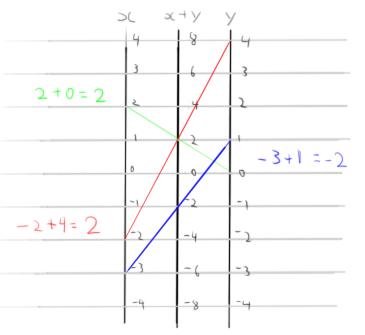
I've always really liked nomograms. They're basically a set of axes drawn on a page in such a way that each axis represents one (or more) variables and by drawing lines between the various axes, it's possible to find unknown variables graphically.

One of the most basic nomograms possible simply adds two numbers:
From this simple beginning, it's possible to make other analog computation devices that are much more sophisticated. By using logarithmic axes, you can perform multiplication, since log(x) + log(y) = log(xy).

Nomograms are rather outdated, now that computers can perform numerical calculations much more easily and with far greater accuracy than anyone can measure by hand. The reason I'm looking into nomograms again is because they can be distributed on paper more easily than a computer program, they are relatively intuitive, and they allow very complex systems of equations to be solved by people who don't know math. There are also some iGEM outreach events coming up...

...so we'd like to be able to show people mathematical modelling stuff that's related to synthetic biology, but it's hard to come up with stuff that's interesting, learnable in minutes, and true. I think it's possible to condense some tricky work into a graph:


The above graph shows a setup that could calculate the concentration of a molecule and its isomers given a reaction rate constant (provided the axes were properly scaled). This is a fair amount of work (for the creator of the nomogram) when you could just plug "exp(-k*t)" into a calculator, but it's hard to beat the connect-the-dots simplicity of a nomograph. The other nice thing about this type of graph is that it really emphasizes the fact that it's easy to 'cheat' and start with the desired final answer and work backwards to get inputs... ie, design the system analytically.

Unfortunately, the irreversible isomerization reaction is still rather lame and even with an easy method of calculating it, it's still not particularly exciting. What would be cool would be to get a system of equations that describes an optimization problem and have a graph visually represent design trade-offs (like the triangular graph on this page), but that sounds like it might be too ambitious for me to tackle in a couple of spare hours.

Tuesday, December 21, 2010

Teleconference

It is not always easy to understand a large group of people speaking into a laptop microphone at the same time.

Sunday, October 31, 2010

Watermelon Carving

Exciting news everyone! I managed to grab the 'gingerich' username on Flickr (I tried for matt, but 210 people beat me to it... actually probably more than that, but matt211 was still available; also someone has majugi as well... grr).

Also, the reason I signed up for a Flickr account, after all this time, is because I don't want to put the entire series of awesome pictures I took of me carving a brain out of a watermelon on this blog. Here's one, though:

EDIT - Other crazy things I forgot to mention: I froze an egg while walking home from the grocery store today. I had noticed that one of my eggs was cracked, so I decided to fry it before it made a bigger mess but I ended up peeling away half the shell before I could 'pour' the egg into the pan. It is also now snowing (very lightly)!

...and the people I'm living with just filled four wine bottles with homemade apple cider (and I mean homemade in the fullest "pressed from apples grown on a friend's apple tree with an apple press built out of a car press and pieces of wood" sense — and the force required to press the apples was enough to shear the head of one of the screws clean off).

Wednesday, October 27, 2010

Voltage Dividers

Note: I found this post while deleting old drafts I never got around to finishing. I have no idea where I was going with it. I think I had some insightful analogy to make that related a voltage divider to life, music, minds, or some really esoteric projects that I have since forgotten. If you happen to think of what that analogy could have been, please let me know.

The sad thing is, I didn't even get around to explaining voltage dividers.

***

This is a voltage divider.

If the input voltage, V, provides a voltage of 5 volts, and resistors R1 and R2 are equal than Vout will be half of V, or 2.5 volts.

Thursday, October 7, 2010

Context-free grammar (Part 1 of 2)

What are context-free grammars? An abstract definition might say that they're a set of rules allowing for the construction of complex structures consisting of logical parts that can be arbitrarily nested, but I've found that nobody really likes my abstract definitions, so I'll try using an analogy instead.

Consider a freight train hauling three containers (containers A, B, and C):

Let's say that container A can only contain livestock, container B transports liquids, and container C contains manufactured goods. It doesn't matter what type of livestock, liquids, and manufactured goods are transported so long as they fit into their respective categories.

We have just defined a very simple grammar. Within this structure, it is possible to have 'phrases' such as "pigs milk computers" or "cows mercury needles".

A cow-mercury-needle train and pig-milk-computer train collision would be unfortunate.

Both the cow-mercury-needle train and the pig-milk-computer train are examples of the same model of train — an A-B-C train — that happen to be carrying different items in their identical containers. The model of the train can be thought of as one rule (or phrase structure) in the grammar, but it is certainly possible to have other rules.

The analogy gets a bit weird here (yes, weirder than the above image) because context free grammars also allow their containers to contain other trains.

Let's imagine a different model of train, the B-A-Weird train that has a B-container (which must, as before, contain a liquid), an A-container (holding livestock) and a weird container which holds either an A-B-C train or a B-A-Weird train. Now instead of a pig-milk-computer train, it would be possible to have a milk-pig-cow-mercury-needle train where the milk is in compartment B, the pigs are in compartment A and the cow-mercury-needle train from above is all in the weird compartment.

Okay, that's pretty weird, but that's not nearly as strange as being able to put a B-A-Weird train inside the Weird compartment. This could allow us to take the entire train we just discussed and stick it in the last compartment of another B-A-Weird train. Then we could take that train and do the same thing, over and over, as much as we would like. However, at this point the train analogy has lost almost all meaning and is likely confusing matters substantially.

Fortunately, there is a familiar application for context-free grammars that should make more sense now, namely language. By specifying containers in terms of parts of speech instead of cargo, we can construct sentences instead of trains. This is sort of reminiscent of Mad Libs: "the {noun} {past tense verb} the {noun}" would be one example of a sentence structure from a context-free grammar. Amusingly, this is also how Matlab's "why" function manages to produce output such as "The bald and not excessively bald and not excessively smart hamster obeyed a terrified and not excessively terrified hamster."

As before though, things get interesting when sentence structures get put inside of other sentence structures (just as trains... get... er, put inside of other trains). We can expand the definition of nouns to include phrases in the structure "{noun} the {noun} {past tense verb}". This allows phrases such as "man the hamster ate" to be used in place of the simple noun "man". And why not? Anywhere you can refer to a man, you can grammatically refer to a specific man who happened to be eaten by a hamster.

There is a slight problem with this setup in that, as before, things get complicated when structures are continually placed inside other structures. The phrase
"The dog the boy the man the hamster ate raised owned bit the boy the man the hamster ate raised."
is in fact valid using the two rules defined above and can be parsed as:
The (dog the (boy the (man the (hamster) ate) raised) owned) bit the (boy the (man the (hamster) ate) raised).
...meaning the hamster ate the man who raised the boy who owned the dog which bit the boy raised by the man eaten by the hamster.

So... yeah, people don't generally speak like that because of cognitive limits to how many nested levels of information we can keep track of at once. But maybe, you say, this idea of context-free grammar could still be useful for creating different kinds of structure. Some sort of really complex structure that can have parts embedded in other parts in ways that are hard for people to imagine. Perhaps, you hazard, some sort of biological structure.

In this last set of thoughts, you've outlined the general idea behind GenoCAD, a context-free grammar for synthetic biology. It seems to be a good fit at first but, as Andre from the UW iGEM team points out, there are quite a few properties of DNA sequences that it fails to capture. More on this later.

Tuesday, October 5, 2010

All the Way


I saw this rainbow as I was biking home today. The crummy cellphone panorama I took of it doesn't do it justice at all, because it was really quite vivid. In fact, looking closely at it revealed that it was a double rainbow with the second, very faint, rainbow surrounding the main one (slightly easier to see in the following picture - sadly this one's from the same cellphone camera).


Anyway, say what you will about guys sobbing hysterically over rainbows (or sing it, if you're so inclined), but know that they are much, much cooler looking live than in recordings.

Friday, September 24, 2010

Popular Neuroscience

This is a personal blog, it is not necessarily a reliable source of information.

I don't normally talk about the work I do on co-op terms, because I don't want to accidentally offend my employers by telling everyone how horribly nice they all are or making the similarly unfortunate error of posting confidential information. However, as I'm currently working for a neuroscience lab and it is pretty awesome I figure it couldn't hurt to write a series of posts about neuroscience stuff. Now, having said all that, here's a confidential training video:


Okay, so that video wasn't actually confidential, but I did steal the link from our lab forum. Now, Cleese's talk is pretty advanced (though quite entertaining), so I'm going to take a step back with a short Q&A (I'm not one to pass up an opportunity to talk to myself).

Q: What is neuroscience?

A: It's the study of the nervous system, nominally. In the long run, neuroscience, psychology, cognitive science, biology, and computer science are all intricately linked in a crazy quest to understand the way we think, the way intelligence and information processing in general works, and how it all somehow works with physical, biological components.

Q: Is neuroscience really that similar to cognitive science? Isn't it really just biology, but concentrating on the nervous system / brain?

A: I'm not very good with all the research classifications in the area, but it seems like most of what's being published under the label of neuroscience is neurobiology. From an experimental perspective this certainly makes sense: the brain is biological, after all, so obviously a substantial amount of the work being done in reverse-engineering it involves biology. Ultimately though, we're largely interested in the functionality of the brain and the way it gives rise to the interesting, complex interactions we all know and love: calling this functionality 'cognition' and attempting to understand said functionality is more or less what cognitive science is about. There is a big gap in understanding currently between neurobiology and cognitive science which is (to grossly and incorrectly simplify things) what theoretical neuroscience is puzzling over.

Q: tl;dr

A: Grr. Ok, look: biological understanding of brain = improving, but massively, insanely complex already and not capable of explaining brain function. Cognitive science = good at finding ways to do specific things; lacks general theories and can't compete with real brains. Gee, it sure would be nice to have people working on some combination of the above things! Those people would definitely deserve enough funding to pay their co-op students. Big time.

Q: I'm not convinced. What's the point of taking multiple different (and possibly conflicting) approaches?

A: First, which one's 'right'? I dunno. That's pretty much answer enough: they both provide more information, thus they're both valid approaches. If they happen to conflict, even better: there would then be an opportunity to investigate and fix problems that are found with the theories. That's pretty much how science works.

Q: Fine, fine. You can start at either the biology or psychological/cognitive levels, I get that. How could you possibly work from the midpoint between the two levels outwards?

A: This conversation makes more sense when it's less abstract. Instead of talking in terms of a 'midpoint' between two different research areas, I should really have framed this as a need to go beyond current empirical biological data to build more functionally complex models. Instead of making hypotheses based solely on raw data, you can start making predictive models constrained by assumptions, information processing requirements, simplifications required for tractability, and so on...

Q: Sorry to interupt, but isn't this post way too long already?

A: Yes.

Wednesday, September 15, 2010

Hand-Eye Impairment


I had a conversation about piano playing with one of the other guys in my house recently. I had been practicing on my keyboard and he admitted that he used to take lessons himself. As most people do, he downplayed his current ability, but I found it interesting that he did this by saying that he used to always memorize pieces so that he could look at his hands (and therefore never really picked up sight-reading).

I've always hated memorizing music and am actually quite dependent on having a piece of paper in front of me. This is frustrating when I'm near someone else's piano (or my own, without music) and someone asks me to play something. Most piano players would just start playing some song they learned when they were ten, but I really don't remember what I've played before. Perhaps more importantly, having to read the music off a page all the time means I have to spend a lot of effort concentrating on reading that could be better used on technique, or artistry, or listening to what I'm playing instead of just playing it.

So with the goal of memorizing some pieces and with the earlier conversation in mind, I tried playing some pieces while looking at my hands instead of the page. It turns out, I really can't do it. In fact, I am far less capable of playing the piano while looking at my hands then I am when I look away entirely or close my eyes. It seems that looking at my hands move prevents me from being able to use them normally, like my brain's not able to cope with the strange new visual feedback that comes from actually watching what I'm doing.

I find this interesting, as it took many long years of conditioning not to look at my hands while playing and it would appear that that conditioning goes pretty deep. Now to go and work on undoing that work...

Sunday, September 12, 2010

Videos, by JoVE!

This post is nothing more than a link to the journal of visualized experiments, because there's really no reason you should be reading my ramblings when you could be watching science.

It's like a Discovery Channel show, except far more specialized, technical, and current.

Also, if you watch the first few seconds of a clip and then are frustrated when it asks for a subscription, you are probably not using the University of Waterloo's network at the moment. If that is the case but you are still a Waterloo student/faculty, do the following: go to lib.uwaterloo.ca and click the connect from home link (or just click the connect from home link in this post, that will work as well), then login and go to http://www.jove.com.proxy.lib.uwaterloo.ca. If that doesn't work, then just do a search for the journal of visualized experiments after logging into the proxy. This is fully worthwhile, really.

Thursday, September 9, 2010

Burning Lips and Soaking Music

The engineering jazz band (With Respect to Time) gig went totally alright tonight. How alright? This alright:
FIRE! RAIN! GLubhuGLabuhGlublargala!

Now you might be thinking: it seems to me that could have gone a little more alright. And you would be partially right! Because, yeah, you know, it wasn't completely perfect and we will probably have to print off some new music (including a copy of that trumpet solo I lost before the set... the panicked improvised version was a more legit jazz solo anyway) but it was kind of fun in an insane Oh God There's Frosh Everywhere And Maybe This One Won't Mind If I Shove Him Out Of My Way With A Trumpet Case kind of way.

I was actually pleasantly surprised by how not outright painful this performance was. I mean that in a completely literal sense: trumpet playing is really quite physical, but it uses muscles (lip muscles) that are hardly ever used for anything else. What that means is that if you haven't practiced for a while, playing a long gig can feel an awful lot like trying to run a marathon without training. As of this Tuesday's rehearsal I was in no shape to run a metaphorical trumpet marathon, but somehow it worked out tonight (thanks are owed to the other two trumpet players who showed up today for pulling us through).

I could go on (so much craziness in one evening!) but tomorrow is still a work day, so I should probably get to the sleeping.

Saturday, September 4, 2010

Parachuter

Just a doodle because I don't have much to do (aside from work-related things and, as it's a Friday late evening — or very early on Saturday, take your pick — those things can wait). This isn't a "journal doodle" or anything like that... although if anyone wants to jump out of some planes it could become one.

EDIT: After posting the first image, I realized I made some significant technical errors in my depiction of the parachutist's neurophysiological response to the fall. Here's a correction.

Wednesday, September 1, 2010

How Recruitment Should Work

"We're kidnapping you for your own good. Promise. Write the code and you'll get flatbread."

Yup, the fall term's about to start. It's probably about time to start working on that fancy recruitment campaign for iGEM that we keep dreaming about... but don't worry non-iGEM people who read this blog (hi family!), I'm planning on writing about something else here.

And that something else is...

Things That I'm Going to Rant About to New Students

I don't really see myself as the ranting type in general, but there's something about getting a fresh, naive, relatively uncynical, and slightly puzzled batch of new students that brings out the old curmudgeon in me. So, in list form, the things I'm going to be giving today's generation of youth an earful about are:
  1. The definition of engineering. It perplexes me how many people get to third year engineering and then act surprised when they find out that engineering is the profession of applying scientific and mathematical principles to practical problems. Even in systems design, which is basically the study of distilled engineering ideology abstracted away from specific domains, there are still people who think it's all about hard hats and accounting. Yes, that's a part, but... well... if that's your image of engineering, you are a personal pet peeve of mine.
  2. Time hoarding. There's time management and then there's being a wuss. I know you've heard the failure rate statistics. I'm sure you've been told it's wise to cut back on extra-curricular activities until you get used to the workload. That's garbage. The easiest way not to fail out is to keep trying to maintain your stupidly over-acheiving lifestyle that got you into university in the first place. If you lower your standards down to "just trying to pass" in first year, you'll never recover. This is a somewhat controversial point and your mileage may vary; nonetheless, you don't have much to lose in first year. Now taking on extra work halfway through second year is a different story.
  3. Ability to write. I know, I know. Given the poor standards of this blog, this point's a bit hypocritical, but I stand by it. My standards are not high: just catch the blatant typos and missed articles and use apostrophes more or less where they should be used. You can throw in semicolons, commas, and colons wherever you want. Deal?
  4. Stop whining. You only get to make lists like this when you're at least half done your degree and even then only once a term. Grad students are allowed unlimited whining, but they've earned it.

Thursday, August 12, 2010

Alternate Reality Campus


I'm not sure what prompted this, but I've had this idea of a "University of Igloo" floating around in my head for a while. I think I originally thought of it as a satire of the University of Waterloo's big rebranding efforts, but I didn't get around to developing it into an actual parody. So here's some guy chilling next to an igloo in the summer.

Post-script: It pains to me admit this, but I originally accidentally capitalized igloo as 'iGloo'.